
Being your own boss has plenty of advantages, but getting a mortgage is not always one of them. Self-employed borrowers face additional scrutiny during the loan process because their income can fluctuate and is documented differently than a traditional W-2 salary.
The good news is that self-employed borrowers qualify for the same mortgage programs as everyone else — conventional, FHA, VA, and jumbo — at the same rates, when their documentation supports the income. For those whose tax returns understate their actual earnings, alternative programs like bank statement loans exist specifically to bridge that gap.
This guide explains what lenders look for, what documentation you need, and how to position yourself for the strongest approval.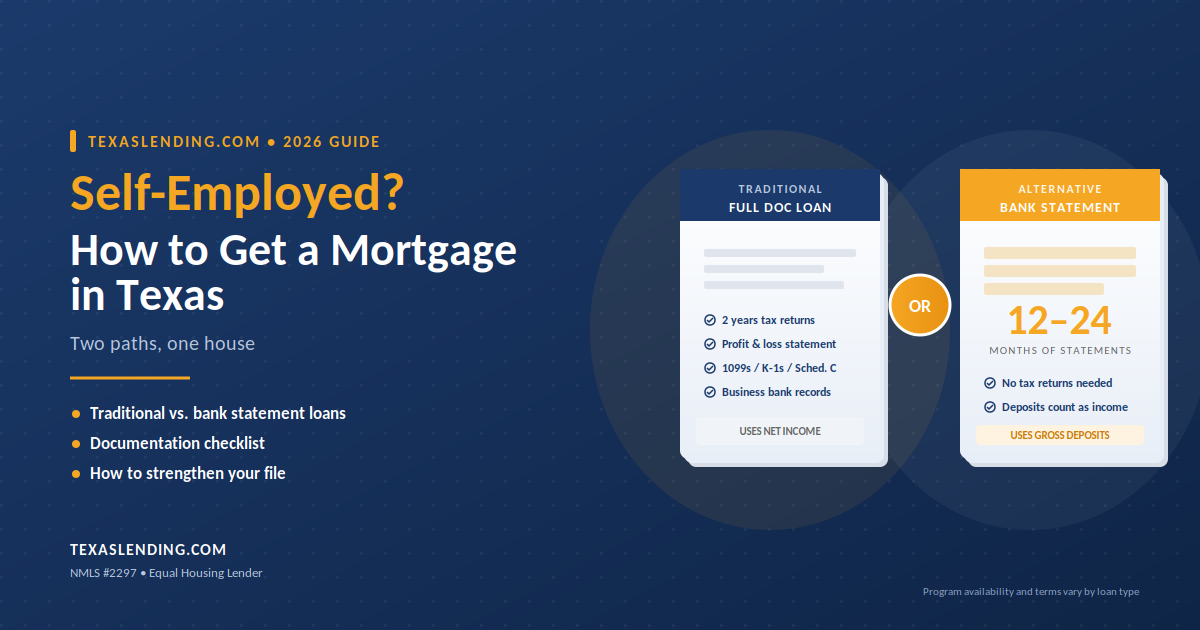
What Lenders Look For From Self-Employed Borrowers
Lenders evaluate self employed mortgage applications the same way they evaluate any other loan — they want to confirm that you have stable, sufficient income to support the monthly payment. The difference is how they verify that income.
● At least two years of self-employment in the same line of work is the standard requirement. Some lenders accept one year if you have prior W-2 experience in the same field.
● Consistent or growing income — Lenders average your income over two years of tax returns. If your income declined significantly from one year to the next, that can raise questions.
● Business viability — Lenders want to see that your business is stable and likely to continue generating income.
Documentation You Will Need
Expect to provide more documentation than a W-2 borrower. Having everything organized before you apply is the single best thing you can do to keep the process on track.
● Two years of personal tax returns with all schedules, including Schedule C for sole proprietors or K-1 for partnerships and S-corps.
● Two years of business tax returns if your business files separately (Form 1120, 1120S, or 1065).
● A year-to-date profit and loss statement — Some lenders require this to be prepared or reviewed by a CPA.
● Business verification — A business license, CPA letter, or proof that the business is active and in good standing.
● Bank statements — Typically 2 to 3 months for a traditional loan, or 12 to 24 months for a bank statement loan program.
Bank Statement Loans: An Alternative Path
If your tax returns understate your real income because of legitimate business deductions, a bank statement loan may be the right fit. These programs qualify you based on 12 to 24 months of bank deposits rather than tax returns, allowing lenders to evaluate your actual cash flow.
Bank statement loans are classified as non-QM (non-qualified mortgage) products. They typically require a minimum credit score of 620 to 660, a down payment of 10 to 20 percent, and at least two years of self-employment history. Interest rates are generally slightly higher than conventional loans, but they provide access to financing that would otherwise be unavailable for many successful business owners.
Not every lender offers bank statement loans. Experienced home lenders Texas self-employed buyers trust, like Texaslending, can help you compare your options across traditional and alternative programs.
📖 Related: Pre-Approval Guide — Learn how to get pre-approved for a mortgage in Texas step by step.
Tips to Strengthen Your Application
● Keep business and personal finances separate — Use dedicated business accounts to make your income pattern clear and easy to verify.
● Time your application carefully — Apply after filing your most recent tax return, and make sure it reflects a strong income year.
● Minimize large or unusual deposits — Unexplained deposits can trigger additional questions and slow down the process.
● Maintain consistent deposit patterns — Steady monthly deposits are more reassuring to underwriters than sporadic large amounts.
● Work with a CPA — A CPA letter documenting your business expenses and true income can significantly improve your approval odds.


