
 If you own a home in Texas, the equity you have built could be one of your most flexible financial tools. A home equity line of credit — better known as a HELOC — lets you borrow against that equity when you need it, in the amount you need, without taking out a full second mortgage upfront.
For homeowners planning renovations, consolidating higher-interest debt, or building a financial cushion for the years ahead, a HELOC can be a smart option. This guide walks through how a Texas HELOC works in 2026, how it compares to a home equity loan, and the Texas-specific rules that make our state a little different from the rest of the country.
What Is a HELOC?
A home equity line of credit is a revolving credit line secured by your home. Instead of receiving a lump sum, you get access to a set credit limit — similar to a credit card — that you can draw from as needed during a set period of time.
You only pay interest on the amount you actually use. As you pay down what you have borrowed, that portion of the credit line becomes available again during the draw period. This is what makes a HELOC different from a traditional home equity loan, which gives you the full amount up front with fixed monthly payments.
How a HELOC Works in Texas
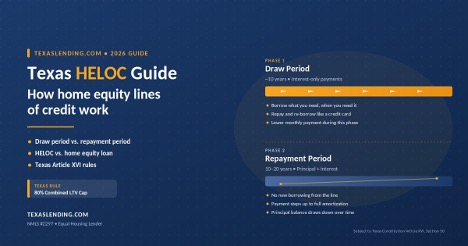
A Texas HELOC has two distinct phases, and understanding both is important before you apply.
The Draw Period
The draw period is when you can borrow from your credit line. This phase typically lasts around 10 years, though terms can vary by lender. During the draw period, you can access funds by transfer, check, or debit card — depending on how the lender sets it up.
Payments during the draw period are usually interest-only, which keeps your monthly obligation lower. Keep in mind that at current mortgage rates, interest-only payments can feel affordable — but they also mean you are not yet paying down the principal balance.
The Repayment Period
Once the draw period ends, the HELOC transitions into repayment. You can no longer borrow from the line, and your payments now include both principal and interest. Repayment periods commonly run 10 to 20 years.
This transition can catch some homeowners off guard, because the monthly payment often jumps significantly when principal repayment kicks in. Planning ahead for that transition is one of the most important parts of using a HELOC responsibly.
→ Home Equity Loans in Texas — See how a fixed lump-sum home equity loan compares to a HELOC.
HELOC vs. Home Equity Loan — Which Is Right for You?
Both a HELOC and a home equity loan let you tap into Home Equity in Texas, but they work differently and suit different situations.
• HELOC — Best for ongoing or unpredictable expenses. Flexible access, interest-only payments during the draw period, variable rate structure. Good for staged renovation projects, tuition costs, or a financial safety net.
• Home Equity Loan — Best for known, one-time expenses. Fixed lump sum, fixed rate, fixed monthly payment. Good for a specific renovation project, debt consolidation, or a large planned purchase.
Your choice usually comes down to how you plan to use the funds. If you know the exact amount you need and want payment predictability, a home equity loan may fit better. If you want flexibility to draw over time, a HELOC gives you room to adapt.
Texas-Specific HELOC Rules You Should Know
Texas home equity lending is governed by the Texas Constitution, Article XVI, Section 50. These rules were written to protect homeowners, and they make Texas home equity lending a little different from other states.
• 80% combined loan-to-value cap — The total of your first mortgage plus your HELOC balance cannot exceed 80% of your home’s appraised value.
• One home equity loan at a time — You can only have one open home equity product on your homestead.
• 12-day cooling-off period — After you apply, Texas law requires a minimum 12-day waiting period before your HELOC can close.
• In-person closing required — Texas home equity closings must take place at a title company, lender’s office, or attorney’s office.
• Fee cap — Lender fees are capped by state law to protect borrowers from excessive closing costs.
These consumer protections give Texas homeowners meaningful safeguards. They can also add a bit of time to the process, so plan for the 12-day minimum when timing your project.
→ Maximize Your Home Equity — Strategies for using home equity wisely — before you tap into it.
Common Uses for a Texas HELOC
A HELOC’s flexibility makes it useful for a range of financial goals. The most common uses we see from Texas homeowners include:
• Home improvements and renovations — Especially staged projects where you need funds over time rather than in one lump sum.
• Debt consolidation — Paying off higher-interest credit cards or personal loans with a lower-cost, home-secured line.
• Education expenses — Covering tuition or education costs that come due semester by semester.
• Emergency reserve — Establishing a low-cost line of credit you can draw from only if needed.
• Investment or business capital — For homeowners with a specific plan and appropriate risk tolerance.
Whatever the purpose, the most important discipline is having a clear plan for how you will use the funds and how you will repay them — especially when the repayment period begins.
How to Qualify for a Texas HELOC
HELOC qualification depends on a mix of factors. Most Texas lenders look at:
• Credit score — Generally 620 or higher, though stronger scores unlock better terms.
• Home equity — You typically need at least 20% equity in your home after the HELOC is factored in (to stay under the 80% CLTV cap).
• Debt-to-income ratio — Most lenders look for a DTI under 43%, though this can vary.
• Income and employment stability — Consistent income helps demonstrate ability to repay both the draw-period payments and the future repayment-period payments.
•
If you own a home in Texas, the equity you have built could be one of your most flexible financial tools. A home equity line of credit — better known as a HELOC — lets you borrow against that equity when you need it, in the amount you need, without taking out a full second mortgage upfront.
For homeowners planning renovations, consolidating higher-interest debt, or building a financial cushion for the years ahead, a HELOC can be a smart option. This guide walks through how a Texas HELOC works in 2026, how it compares to a home equity loan, and the Texas-specific rules that make our state a little different from the rest of the country.
What Is a HELOC?
A home equity line of credit is a revolving credit line secured by your home. Instead of receiving a lump sum, you get access to a set credit limit — similar to a credit card — that you can draw from as needed during a set period of time.
You only pay interest on the amount you actually use. As you pay down what you have borrowed, that portion of the credit line becomes available again during the draw period. This is what makes a HELOC different from a traditional home equity loan, which gives you the full amount up front with fixed monthly payments.
How a HELOC Works in Texas
A Texas HELOC has two distinct phases, and understanding both is important before you apply.
The Draw Period
The draw period is when you can borrow from your credit line. This phase typically lasts around 10 years, though terms can vary by lender. During the draw period, you can access funds by transfer, check, or debit card — depending on how the lender sets it up.
Payments during the draw period are usually interest-only, which keeps your monthly obligation lower. Keep in mind that at current mortgage rates, interest-only payments can feel affordable — but they also mean you are not yet paying down the principal balance.
The Repayment Period
Once the draw period ends, the HELOC transitions into repayment. You can no longer borrow from the line, and your payments now include both principal and interest. Repayment periods commonly run 10 to 20 years.
This transition can catch some homeowners off guard, because the monthly payment often jumps significantly when principal repayment kicks in. Planning ahead for that transition is one of the most important parts of using a HELOC responsibly.
→ Home Equity Loans in Texas — See how a fixed lump-sum home equity loan compares to a HELOC.
HELOC vs. Home Equity Loan — Which Is Right for You?
Both a HELOC and a home equity loan let you tap into Home Equity in Texas, but they work differently and suit different situations.
• HELOC — Best for ongoing or unpredictable expenses. Flexible access, interest-only payments during the draw period, variable rate structure. Good for staged renovation projects, tuition costs, or a financial safety net.
• Home Equity Loan — Best for known, one-time expenses. Fixed lump sum, fixed rate, fixed monthly payment. Good for a specific renovation project, debt consolidation, or a large planned purchase.
Your choice usually comes down to how you plan to use the funds. If you know the exact amount you need and want payment predictability, a home equity loan may fit better. If you want flexibility to draw over time, a HELOC gives you room to adapt.
Texas-Specific HELOC Rules You Should Know
Texas home equity lending is governed by the Texas Constitution, Article XVI, Section 50. These rules were written to protect homeowners, and they make Texas home equity lending a little different from other states.
• 80% combined loan-to-value cap — The total of your first mortgage plus your HELOC balance cannot exceed 80% of your home’s appraised value.
• One home equity loan at a time — You can only have one open home equity product on your homestead.
• 12-day cooling-off period — After you apply, Texas law requires a minimum 12-day waiting period before your HELOC can close.
• In-person closing required — Texas home equity closings must take place at a title company, lender’s office, or attorney’s office.
• Fee cap — Lender fees are capped by state law to protect borrowers from excessive closing costs.
These consumer protections give Texas homeowners meaningful safeguards. They can also add a bit of time to the process, so plan for the 12-day minimum when timing your project.
→ Maximize Your Home Equity — Strategies for using home equity wisely — before you tap into it.
Common Uses for a Texas HELOC
A HELOC’s flexibility makes it useful for a range of financial goals. The most common uses we see from Texas homeowners include:
• Home improvements and renovations — Especially staged projects where you need funds over time rather than in one lump sum.
• Debt consolidation — Paying off higher-interest credit cards or personal loans with a lower-cost, home-secured line.
• Education expenses — Covering tuition or education costs that come due semester by semester.
• Emergency reserve — Establishing a low-cost line of credit you can draw from only if needed.
• Investment or business capital — For homeowners with a specific plan and appropriate risk tolerance.
Whatever the purpose, the most important discipline is having a clear plan for how you will use the funds and how you will repay them — especially when the repayment period begins.
How to Qualify for a Texas HELOC
HELOC qualification depends on a mix of factors. Most Texas lenders look at:
• Credit score — Generally 620 or higher, though stronger scores unlock better terms.
• Home equity — You typically need at least 20% equity in your home after the HELOC is factored in (to stay under the 80% CLTV cap).
• Debt-to-income ratio — Most lenders look for a DTI under 43%, though this can vary.
• Income and employment stability — Consistent income helps demonstrate ability to repay both the draw-period payments and the future repayment-period payments.
• Property type — Primary residence homestead is the most common; non-owner-occupied properties may have different rules.
A licensed mortgage consultant can walk you through your specific numbers and help you understand what a HELOC would look like in your situation.
→ Learn More About HELOC Options — See current HELOC options from TexasLending and get personalized guidance.
Ready to Explore Your HELOC Options?
Every homeowner’s situation is different, and the right home equity strategy depends on your goals, timeline, and financial picture. The TexasLending team has helped Texas homeowners navigate home equity decisions for more than 25 years — and we are here when you are ready to have that conversation.
→ Get Started with TexasLending.com ←
Not sure yet? Try our home purchase and payment calculators to see what different scenarios could look like.
→ Try Our Purchase Calculator ← — Primary residence homestead is the most common; non-owner-occupied properties may have different rules.
A licensed mortgage consultant can walk you through your specific numbers and help you understand what a HELOC would look like in your situation.
→ Learn More About HELOC Options — See current HELOC options from TexasLending and get personalized guidance.
Ready to Explore Your HELOC Options?
Every homeowner’s situation is different, and the right home equity strategy depends on your goals, timeline, and financial picture. The TexasLending team has helped Texas homeowners navigate home equity decisions for more than 25 years — and we are here when you are ready to have that conversation.
→ Get Started with TexasLending.com ←
Not sure yet? Try our home purchase and payment calculators to see what different scenarios could look like.


